

Why doesn't just knowing your behaviour patterns change them?
I've heard that question in coaching sessions and leadership workshops, and I've asked it of myself more times than I'd like to admit, usually with a sigh, right after doing the exact thing I'd promised myself I'd stop doing. It's also the reason The SelfLed Mind exists, so it felt like the right place to start.
For nearly 14 years I worked inside a global tech company, the last five leading the coaching and team development strategy for 1,300 leaders. I designed programmes, brought in coaches and sat in on sessions where leaders had real breakthroughs about how they lead.
What that taught me is that the breakthrough is only half the work. The other half happens afterwards, back at your desk, when nobody is facilitating. That's true of any coaching or development, however good it is, and that second half belongs to the leader. I know it from the inside too: I knew I said yes too much and I knew why, yet I kept saying yes anyway.
Research from the NeuroLeadership Institute on making learning stick points the same way. Ideas last longer when you generate them yourself and come back to them over time, rather than hearing them once (Davachi et al., 2010). In other words, what you do after the session matters as much as the learning that happens in the session itself. Owning that part, and turning an insight into a habit, is where self-leadership comes in.
What is self-leadership?
Self-leadership is owning and driving your own behaviour. In practice, that means noticing what you do and why, choosing how you respond and following through until the new way becomes a habit.
This really matters when you step up a level, from expert to enabler. For years your value came from knowing the answer. Now it comes from building a team that can find answers without you, and that's a mindset switch that takes conscious choice.
The trouble is that the behaviours that earned you the promotion don't switch off when the job title changes. Under pressure, you keep doing what made you successful: answering the question, fixing the problem, getting the work over the line yourself. It feels helpful. Meanwhile your team learns to wait for you, decisions pile up on your side of the desk and the strategic work your new role needs keeps sliding to next week.
So the first person you have to lead when you move from expert to enabler is yourself.
Why doesn't awareness change behaviour?
Mostly because a lot of what we do runs on autopilot, triggered by the situation before we’ve consciously decided anything.
Habits form when we repeat the same response in the same situation. Once a habit has formed, the situation itself triggers it: the meeting, the person, the kind of pressure. A major review of habit research found that habits are largely unmoved by changes in our goals or intentions, and that they take over when we're stressed or distracted (Wood and Rünger, 2016).
That's the catch for leaders. Insight tends to arrive away from the action: in a coaching session, on a course, reading a 360 report with a cup of tea. Your habit doesn't live there. It lives in the stand-up, the escalation and the message from your manager, and that's where it fires, before your new insight (and good intention) has a chance to step in.
So if you keep repeating a pattern you know needs to change, it isn't a sign you haven't tried hard enough. Your brain is doing what it's built to do: running well-practised behaviour on autopilot, so your attention is free for everything else on a packed day. Most of the time that's a gift, and sometimes it's a royal pain in the butt.
Once you can see the pattern, though, it isn't running in the dark any more. What you do next is yours to own in the light of day.
What does change behaviour?
Behaviour changes when a new response is practised in the same situations that trigger the old one, again and again, until it starts to happen without effort. In one study, people adding a simple daily habit took around two months on average to reach that point, with a wide range from person to person (Lally et al., 2010). So no, it's not 21 days, sorry!
Insight gets you started, and repetition in the real situation is what carries it through.
That's what my framework, The SelfLed SHIFT™, is built around: a practical way of moving from autopilot to intentional action and lasting change. Here's how its five stages might play out for one leader.
Imagine a leader who has just stepped up from managing a team to leading several managers.
See (awareness): She notices a big chunk of her day goes on answering questions from the team, so she looks more closely at the situation. Whenever someone in her managers' teams posts a question in the group channel, she answers it within minutes, before any of her managers get the chance. Is it a pattern? Almost every time.
Hold (regulation): The next time a question gets posted, before her fingers hit the keyboard, she pauses to ask what's really happening. What feels at risk is being seen as responsive and on top of things, and letting go of being the one with the answer.
Intention (choice): She asks herself which perspective she wants to respond from. Until now, the lens has been "a good leader has the answer". She chooses a different one: "a good leader grows people who have the answer". Through that lens, a question in the channel stops being something to fix fast and becomes a chance for one of her managers to step up.
Follow Through (behaviour): She picks one small, concrete action to test. For the next two weeks, she waits half an hour before replying, and when she does reply, she tags the relevant manager and asks what they think.
Transform (impact): She keeps it going and reflects on what's changing. Her managers start answering first, fewer questions land with her, and she has room for the cross-team work her role needs. That's when she can ask herself what else is becoming possible.
Most of us want to start at Intention ("right, from now on I'll…") with a pattern we've only half seen, without linking it to a specific behaviour in a specific situation. That's why ‘See’ comes first.
Where do you start?
Start with See, and give it a week.
Pick one leadership behaviour you'd like to change. For example: jumping in with the answer, taking work back once you've handed it over, saying yes to every meeting, or going quiet when you disagree with someone more senior.
Describe what it looks like in autopilot mode. What do you do, say or think when it shows up? Be as specific as you would be if you had to describe it to someone else.
Notice when it shows up, and what's around you when it does. The meeting, the people, the kind of pressure. Jot it down each time.
Resist the urge to fix it straight away. The more detail you collect now, the easier it is to choose what to do differently next.
Interested to unpack this further for yourself?
I work with leaders including those making the move from expert to enabler, through 1:1 leadership coaching, and with the teams around them. If you'd like to explore your own pattern with some guided support, you can get in touch through my website or drop me (Rebecca) an email at info@theselfledmind.com
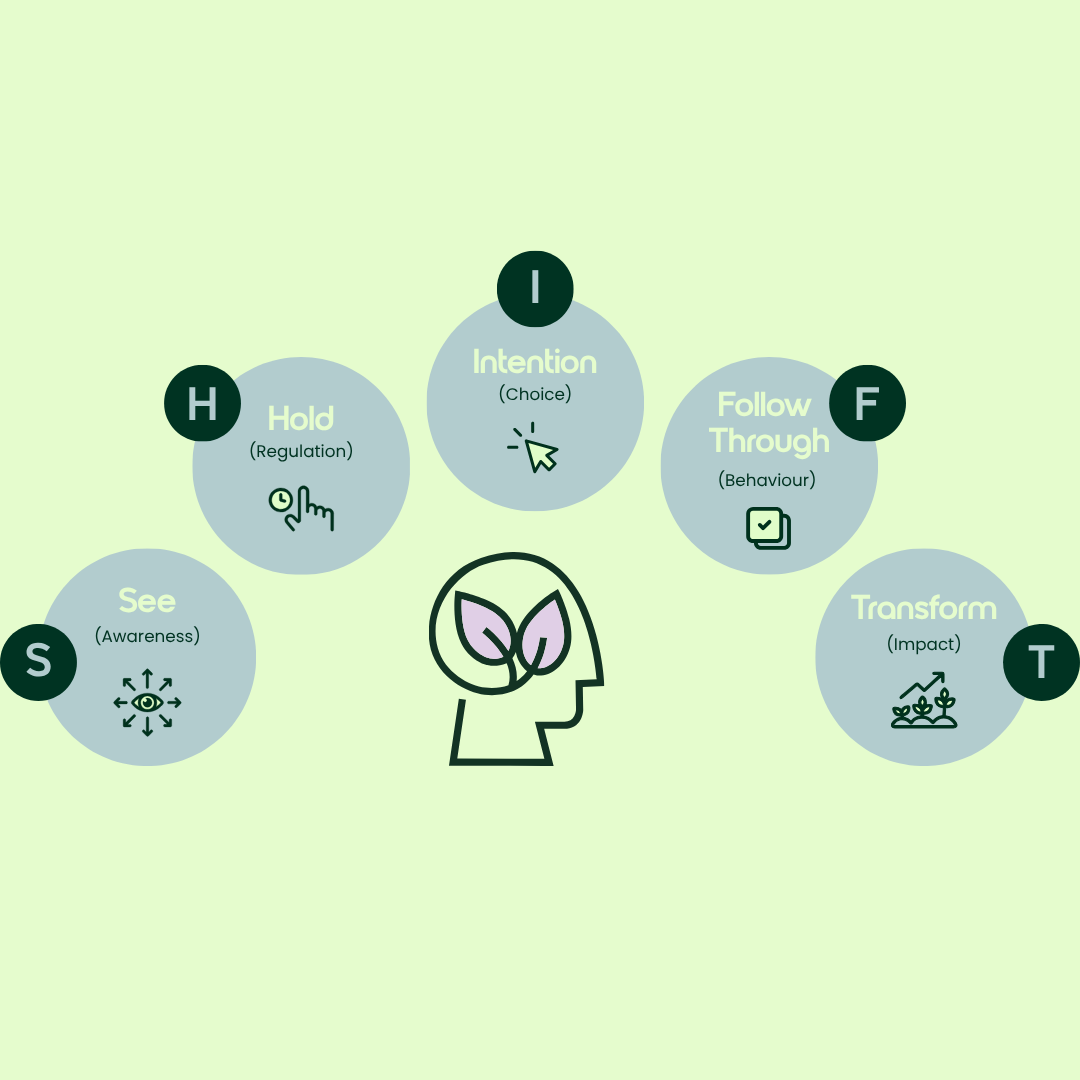
The SelfLed SHIFT™ framework underpins the approach taken in coaching sessions focused on behaviour change and habit formation.
